
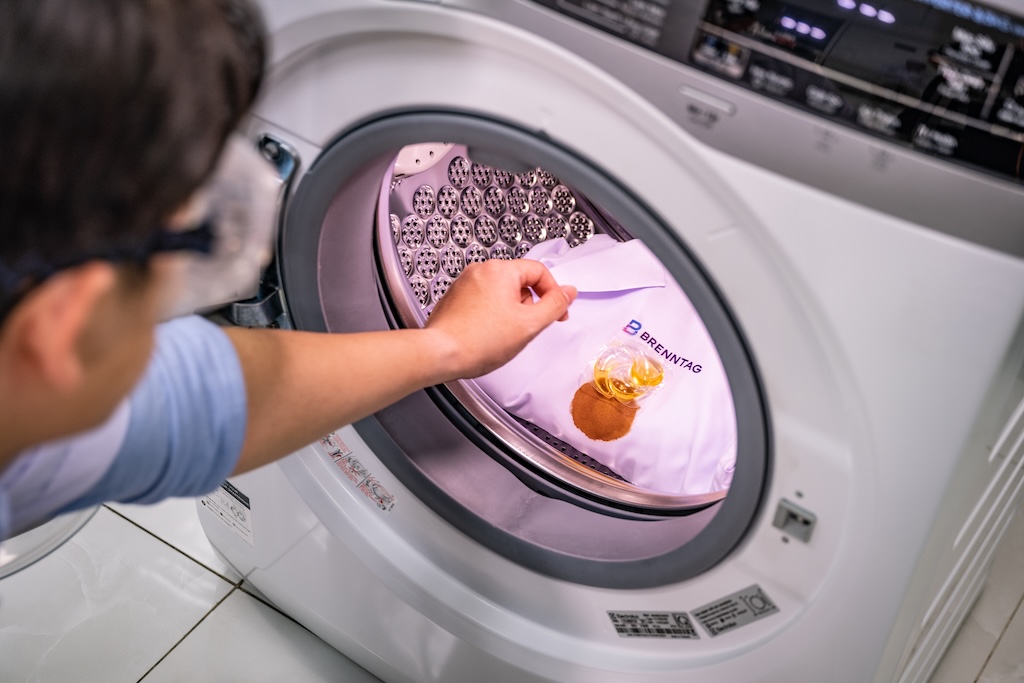


AECI Specialty Chemicals explains the history behind the technology and how the application focus of emulsions has changed.
For the longest time, w/o emulsions were reserved for use in sunscreens, waterproof makeup and nappy (barrier) creams. Yet, over the years, emulsion technology has evolved widening the range of applications for emulsions to everyday personal care products.
Firstly, let’s talk about the main difference between water-in-oil (w/o) and oil-in-water (o/w) emulsions. The bottom line is water and oil are not miscible, so emulsifiers are needed to mix the two and create a stable end-product.
In colloidal science, the ‘inside’ phase is called the dispersed phase while the ‘outside’ phase is referred to as the continuous phase. In a w/o emulsion, the water is the dispersed phase and the oil, the continuous phase.
W/o offers several practical advantages because the oil is on the ‘outside’. For example, the end-product feels oily to the touch – which is commonly experienced with sunscreens. This characteristic enables water resistance, which is why w/o is the preferred emulsion type for sunscreens, waterproof makeup and barrier creams.

The lipid barrier also locks in moisture, so w/o emulsions are great for problematic skin prone to psoriasis, eczema and dryness. This begs the question, why are the majority of personal care creams o/w, which is the opposite type of emulsion?
Selecting w/o emulsions and emollients
In the past, w/o emulsions were perceived as sticky, greasy, heavy, hard to stabilise and expensive. However, scientific advances have addressed and counteracted these issues over time. It is now possible to easily produce w/o emulsions that are cost-effective, easy to stabilise, fast absorbing, feel light on skin (where required), and are non-tacky. These factors are addressed by two main components of the formulation, being the choice of emulsifier and the selection of emollients.
AECI Specialty Chemicals has a solution for both ingredient types. Its easy-to-use w/o emulsifier base is supplied in a viscous liquid format and is used at very low dosages between 1.8% and 3%.
In w/o emulsions, increasing the dispersed phase content increases the viscosity of the final emulsion. Thus, oil phases in the order of 10% to 15% yield thick creams, while oil phases in the range of 18% to 35% yield lower viscosity lotions. The other advantage of w/o is that the viscosity of the oil phase is proportional to the final emulsion viscosity, due to the oil phase being the continuous phase. This means that adding cosmetic waxes, butters and even petrolatum, will significantly alter the structure of the emulsion, allowing applications like beauty balms and body butters.
The choice of emollient is critical to the sensory experience of a final product. Selecting more volatile emollients with high spreading coefficients, such as silicones, squalanes and certain alkanes, achieves light emulsions that penetrate the skin easily. Similarly, when more occlusive emollients are used, like mineral oil and certain vegetable oils, heavier emulsions are created. A heavier emulsion performs better at preventing transepidermal water loss, effectively increasing moisturisation.
The lipid barrier also locks in moisture, so w/o emulsions are great for problematic skin
Get in touch with AECI Specialty Chemicals
Equally beneficial for hair care
Of course, the technology is not limited to skincare. Because these emulsions can be designed with such large quantities of oil, it also makes them perfect for certain hair care products such as oil moisturizers, masks, hair foods and serums. Imagine combining a blend of nourishing oils that are highly favoured by consumers, such as argan oil, coconut oil, Abyssinian oil and sapote oil, and saving costs in the process. The cost savings are made possible by the emulsifier, which allows for water to be included in the formulation without hampering the performance of the oils.

W/O innovation to replace petroleum jelly
Petroleum jelly, also known as petrolatum, white petrolatum, soft paraffin and multi-hydrocarbon, is a semi-solid mixture of hydrocarbons (with carbon numbers mainly higher than 25). It was originally promoted as a topical ointment for its healing properties. Since 1870, the Vaseline brand has been a well-known American brand of petroleum jelly.
After petroleum jelly became a medicine-chest staple, consumers began to use it for cosmetic purposes to moisturise the skin, remove eye makeup, save split ends and preventing skin stains from hair dye. It is also used for many ailments including toenail fungus, nosebleeds, diaper rash and common colds.
The traditional medicinal value of petroleum jelly as a ‘cure-all’ has since been limited by better scientific understanding of appropriate and inappropriate uses. It is recognised by the U.S. Food and Drug Administration as an approved over the counter (OTC) skin protectant and remains widely used in cosmetic skin care, where it is often loosely referred to as mineral oil.
Due to supply chain challenges, microcrystalline wax and slackwax are imported for the manufacture of petroleum jelly. This has resulted in a huge increase in the price of petroleum jelly. The increase in cost together with the negative connotation of petroleum-based products are key drivers of innovation that lead to the development of a cost-effective jelly balm by AECI Specialty Chemicals.
This formulation is featured in Table 1.

The highly cost-effective jelly balm yields a beautifully glossy, petroleum jelly-free product that radiantly moisturises the skin.



Leave a Reply
You must be logged in to post a comment. Need an account? Register here.